


G-spot: a complete guide to finding, stimulating, and reaching orgasm
By Coline Levin
|
Summarize this article with AI


You’ve heard about the G-spot. Perhaps you’ve looked for it without ever finding it. Perhaps you think it’s a myth. Or perhaps you’ve discovered it by accident and would love to find it again.
At Puissante, we’re going to tell you the truth about the G-spot: it’s complicated, but not impossible. And above all, it’s really interesting to explore.
Yes, there is a hyper-sensitive area inside the vagina that, when stimulated correctly, can create incredible sensations. Is it a unique, well-defined structure as was long believed? No. Is it real? Absolutely. Let us explain.
Does the G-spot really exist? (the true scientific answer)
To start, we turn to science, because it is important to fully understand what you are looking for.
For a long time, the G-spot was presented as a well-defined hyper-erogenous zone, a kind of "magic button" inside the vagina. The zone owes its name to the German gynecologist Ernst Gräfenberg, who described it in the 1950s, but it was the book The G-spot and other discoveries about human sexuality, published in 1982, that popularized the term and the idea of a single point.
But here's the thing: subsequent scientific research has shown that it’s more complicated than that.
What modern science says
According to a landmark study published in Nature Reviews Urology, researchers discovered that there is no single, well-defined structure that one could call "the G-spot." Instead, they propose the concept of a "clitourethrovaginal (CUV) complex": a multifaceted and variable zone that encompasses the dynamic interactions between the clitoris, urethra, and the anterior vaginal wall.
In other words: it is a complex area, not a single small pearl, and it varies enormously from one woman to another. A more recent systematic review, covering 31 studies, confirms this finding: the majority of women do report having a sensitive area of this type, but no scientific consensus exists on its exact location, size, or precise nature.
Some researchers, like Terence Hines, go further and consider the G-spot a "modern gynecological myth," based on anecdotal observations rather than solid anatomical evidence.
What this means for you
Here is the deal: the G-spot is not a myth, but it’s not a single, universal structure either. It is a sensitive area that exists, but that:
- varies enormously from one woman to another;
- can be more or less sensitive depending on your menstrual cycle;
- requires specific stimulation to really "wake up";
- is not always easy to find (and it’s okay if you never find it).
The good news? You don’t need to understand neuro-anatomy to enjoy it. You just need to know where to look and how to stimulate.
Where is the G-spot located? (precise location)
The G-spot is a sensitive area located on the anterior wall of the vagina (the wall on the pubic side, not the rectal side).
Precise location:
- about 3 to 5 cm inside the vagina, moving up towards the pubis;
- you can find it by inserting a finger (or two) while leaning slightly forward;
- the texture is generally rougher and bumpier than the rest of the vaginal wall;
- it is often described as being the size of a coin or a small pea.
How to recognize it:
When you find it, you will feel a slight sensation of needing to urinate (because it is close to the urethra). Don’t worry, this is not abnormal. Continue gently and the sensation will often turn into pleasure.
Finding the G-spot on your own: a practical guide
Looking for the G-spot on your own is a great way to get to know your body. And it’s important to do it at your own pace, without pressure.
Preparation
Before starting, really take your time. Don't rush. You need to be relaxed to feel the sensations. Clean your hands and trim your nails if necessary: short nails are better to avoid small tears.
Use a high-quality water-based lubricant. This is really important, both for comfort and to fully feel the sensations. Create an atmosphere where you feel good: soft music, dim lighting, no stress. Your environment matters.
The technique
Start by getting aroused. Caress your clitoris, your breasts, your erogenous zones. You need to be at least slightly aroused for the G-spot to "wake up." Yes, really. Once you are aroused, insert one or two fingers into your vagina. Go slowly.
Now search for the rough area on the anterior wall (the one towards your pubis). You can make small "come here" motions with your finger, as if you were beckoning. Many women find that this movement is more effective than back-and-forth strokes. If you don’t find it right away, that’s normal. Keep exploring. Try different areas, different pressures. Every woman is different.
Once you find an area that you like, adjust the pressure and the rhythm. Some women like light, constant pressure. Others like faster movements. The important thing is to listen to your body and see what feels good to you.
With a sex toy: easier and more pleasant
Honestly? Finding the G-spot with a rabbit vibrator or a G-spot stimulator is often easier than with your fingers.
Why? Because:
- The angle is better. Sex toys are designed to reach this specific area.
- The stimulation is more intense. The vibrations really help to "wake up" the area.
- You can relax. You don’t need to contort yourself to find the right angle.
- It’s more hygienic. No risk of small tears from fingernails.
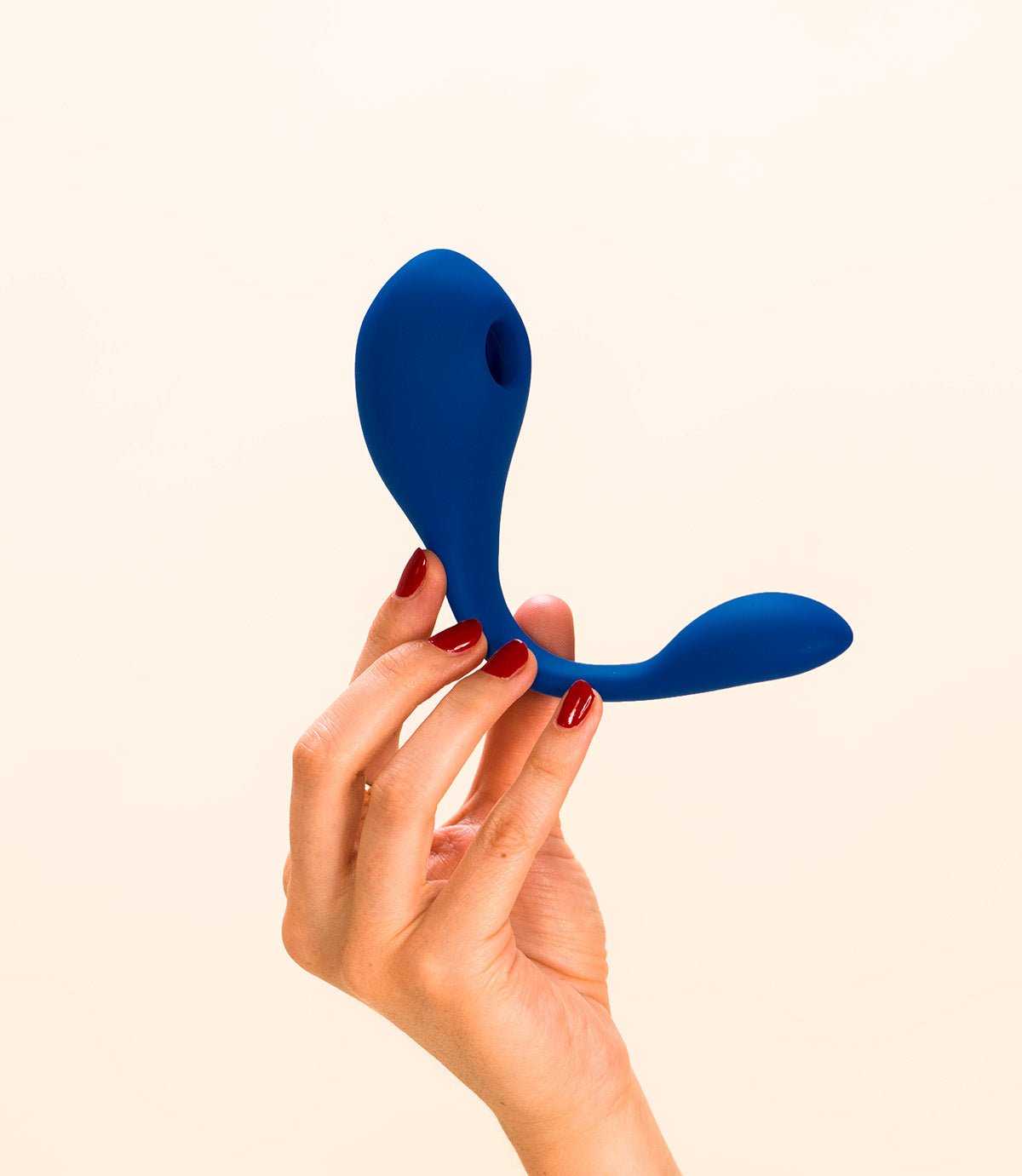
The Chouchou is particularly effective for the G-spot thanks to its specific curvature and double stimulation. But any well-designed rabbit or G-spot stimulator can do the trick.
Stimulating the G-spot with a partner: the positions that work
Now, let’s talk about the real deal: making love with someone else and enjoying the G-spot. That is a different story than looking for it on your own.
Why some positions work better
To stimulate the G-spot with a partner, you need a position where:
- Penetration targets the anterior wall of the vagina. That is to say, the wall on the pubic side.
- The angle allows for constant stimulation. Not just during penetration, but throughout the act.
- Your partner can have access to your clitoris. Because yes, double stimulation (G-spot + clitoris) is much more effective.
The best positions for the G-spot
1. The doggy style position
It’s the classic for a good reason. When you are on all fours and your partner enters you from behind, their penetration naturally targets the anterior wall of your vagina.
To maximize G-spot stimulation, lower your pelvis slightly (arch your back a little) and ask your partner to penetrate a little less deeply but at a more pronounced angle towards the front. You can caress your clitoris during this, or your partner can do it.
It’s easy to set up, the angle is naturally good, and you have your hands free for clitoral stimulation.
2. The missionary position with adjustment
Missionary isn’t bad for the G-spot if you make a few adjustments. Place a pillow under your hips to elevate your pelvis, and ask your partner to enter at a slightly upward angle (towards your pubis).
You can also squeeze your thighs to increase friction and direct the penetration forward. Your partner can stimulate the clitoris with their fingers or a sex toy during this time. The advantage is that you can kiss your partner, there is emotional contact, and it’s easy to adjust the angle based on your sensations.
3. The cowgirl position with variation
When you are on top, you have total control. This is perfect for finding the angle that stimulates your G-spot. Instead of moving up and down (vertical movement), lean slightly forward and make horizontal back-and-forth movements.
This angle targets the anterior wall. You can also lean further forward to increase pressure on the G-spot. The main advantage is that you have complete control over the angle and depth. It’s ideal for finding exactly what you like.
4. The chair position
Your partner sits on a chair, you sit on them (facing them or with your back to them).
Sit facing them and lean back a little. This angle targets the anterior wall and you have your hands free to caress yourself. It’s intimate, the angle is excellent, and you can adjust yourself easily.
5. The "spooning" position
You are lying on your side, your partner is behind you and enters from behind. Bend your legs a little (don't keep them fully extended) and ask your partner to enter at a slightly forward angle. This is a very intimate and gentle position, very comfortable, and the angle can be excellent for the G-spot.
General tips for all partners
Communication is very important. Tell your partner if it feels good, if it’s too deep, if the angle is right...
Go slowly at first: you need time for the G-spot to "wake up."
Be patient; you may need several sessions before you really feel something. Always combine with clitoral stimulation if possible. The G-spot on its own is good. The G-spot + clitoris is much better.
If penetration causes discomfort or pain rather than pleasure, it is not normal: this can have several causes (lack of lubrication, muscle tension, dyspareunia) and deserves to be discussed with a health professional.
And don't hesitate to use a sex toy, even as a couple, as it helps to intensify the sensations.
Using a sex toy to stimulate the G-spot
A good sex toy for the G-spot is truly a game-changer. Here is what you need to know.
Which type of sex toy to choose?
Rabbits (like the Chouchou) have a curved main branch that targets the G-spot and an external branch for the clitoris. It’s perfect for double stimulation. They offer a curvature specifically designed for the G-spot, a variety of vibration modes, and you can use them alone or as a couple.
How to use it
Alone, insert the sex toy into your vagina and find the angle that stimulates the G-spot (you will feel a slight sensation of needing to urinate; that’s normal). Gradually increase the vibration and move the toy slightly to find the best angle. Let yourself go and enjoy.
As a couple, your partner can use it on you during foreplay. They can also use it during penetration (some rabbits are designed for this). Or you can use it on yourself while your partner penetrates you. It’s up to you to see what you like best.
Cleaning and maintenance
Before and after each use, clean it with warm water and mild soap. Use a water-based lubricant (never silicone, it damages the sex toy). Store it in a fabric pouch, in a cool, dry place. For more details, consult our complete guide on how to clean a silicone sex toy.
Sensations and G-spot orgasms: what to expect?
Now, let’s talk about the real question: what does it feel like when the G-spot is stimulated?
The sensations
Every woman describes it differently. Many report a sensation of needing to urinate at first; this is normal and usually passes as you continue.
Others describe a feeling of pressure or fullness, different from clitoral stimulation.
Some women experience a sensation of "depth," as if the orgasm were coming from deeper within their body.
G-spot orgasms
Orgasms originating from the G-spot are often described as deeper, because they involve the entire vagina and not just the clitoris. They can also last longer than a clitoral orgasm, and some women find them more intense. But above all, they are simply different from a clitoral orgasm—not necessarily "better," just different.
And if you never find it?
That’s okay. Really. Some women never find their G-spot, and that is completely normal. Anatomy varies enormously from one woman to another. Your pleasure does not depend on finding the G-spot.
Myths and realities about the G-spot
- You may have heard that "the G-spot makes all women reach orgasm."
That’s false. Some women find G-spot stimulation incredible. Others feel nothing. Others find it uncomfortable. That’s normal and that’s okay.
- You may also have read that there is "a magic position that always stimulates it."
False as well. What works for one woman may not work for another. Anatomy varies enormously.
- And then there is the idea that "if you don’t orgasm from the G-spot, there is a problem."
No. There is no problem. Your body works just as it should.
- Finally, many people think that "the G-spot is a single, well-defined structure."
It’s complicated. As we have seen, what we call the "G-spot" is actually a complex and variable zone that changes from one woman to the next.
FAQ: your questions about the G-spot
Is it normal to feel a need to urinate?
Yes, completely normal. The G-spot is close to the urethra. Continue gently and the sensation should turn into pleasure.
How long does it take to find the G-spot?
It varies. Some women find it the first time. Others need to explore for several weeks or months. No pressure when it comes to sexuality.
Is it true that some women ejaculate when the G-spot is stimulated?
Yes, it’s possible. But it’s rare and it’s not an indication that you are doing it "right" or "wrong." It’s just a normal variation.
Can my partner find the G-spot with their penis?
Yes, with the right position. But it is often easier with a sex toy or fingers.
Does the G-spot change with age?
Yes, slightly. After menopause, sensitivity may change. But you can still stimulate it.
Can the G-spot help me if I have trouble reaching orgasm?
Perhaps. Some women find that G-spot stimulation helps them. Others find that it must be combined with clitoral stimulation. Explore and see what works for you.
The final message
The G-spot exists. It is not a myth. But it is not a single, universal structure either. It is a sensitive area that varies enormously from one woman to another.
The important thing is not to "find" it or to "conquer" it. The important thing is to explore your body, discover what you like, and experience pleasure.
Some women love G-spot stimulation. Others prefer clitoral stimulation. Others like both. All of that is normal.
Use the tools you like (your fingers, a sex toy, your partner), and above all, listen to your body; it has so many things to tell you.
en/en/
Coline Levin
You will surely like it
-
Coco
119,00€ -

Chouchou
109,00€ -

Lubricating Intimate Gel
13,00€
Coco

Chouchou

Lubricating Intimate Gel


